
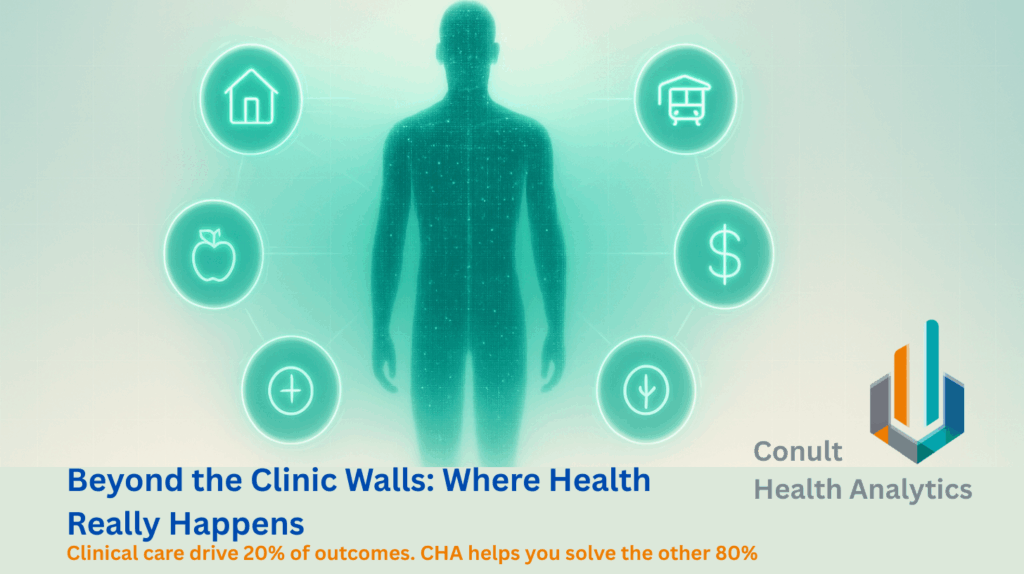
Context matters more than we often admit. Social determinants of health in value-based care are reshaping how hospitals and payers measure success. At Conult Health Analytics, we believe the next generation of value-based care depends on understanding the social context behind every clinical outcome.
Clinical medicine influences only part of a person's health. A 2022 U.S. Department of Health and Human Services (HHS) evidence review estimated that clinical care explains only ~20% of county-level variation in health outcomes, while social determinants of health (SDoH) factors like housing, education, transportation and poverty can account for up to 50%. Socio-economic factors alone may explain almost half of health outcomes. This means that value-based care cannot reach its promise of better outcomes at lower costs without addressing the social and economic conditions that shape patients' lives.
What are SDoH?
The National Institutes of Health describes SDoH as the conditions in which people live, learn, work and socialize. They cover five domains: economic stability, education access and quality, access to quality healthcare, neighborhood and built environment, and social/community support. Structural factors such as economic inequality, discrimination, lack of transportation and unstable housing influence whether patients can seek care, adhere to treatment and recover successfully. For example, transportation barriers, which disproportionately affect low-income and elderly populations, lead to missed appointments and worse chronic disease management. Post-discharge, unstable housing and limited community support increase hospital readmissions and impede recovery. These are not side issues; they drive costs, outcomes and equity.
Evidence That SDoH Drives Outcomes
High impact: HHS reports that clinical care contributes about 16% to individual health outcomes, whereas SDoH may explain up to 47%. The NEJM Catalyst notes that SDoH influence 80-90% of patient outcomes, dwarfing traditional medical care.
Policy action: The Centers for Medicare & Medicaid Services (CMS) expanded Medicare Advantage supplemental benefits in 2019, allowing plans to offer non-medical services such as transportation, healthy meals and home-environment modifications. Today 35 states require managed care organizations to screen members for SDoH and enroll them in support services ranging from homelessness support to healthy-behavior incentives.
Cost and quality: Real-world initiatives show that connecting diabetic patients to community-based organizations to address food insecurity and transportation improved outcomes and reduced costs. Addressing SDoH for high-utilization populations led to higher quality care at lower cost and demonstrated the flexibility of technology to tailor interventions.
Why Value-Based Care Needs SDoH Data
Value-based care contracts tie payments to outcomes rather than volume. To succeed, they require robust data. A 2024 analysis from Holland & Knight notes that sophisticated data management is essential for these models: Alternative payment models demand frequent measurement, data analysis and reporting to track quality and performance. Data must include clinical, financial and SDoH information such as housing status or transportation access to proactively manage populations. Without an integrated dataset at the individual and population level, advanced value-based care models cannot be deployed.
This means organizations must build pipelines that combine electronic health records with survey data, claims-derived Z-codes, geospatial information and algorithms that extract SDoH insights from unstructured records. Yet a 2021 survey found that only 62% of health systems systematically screen target populations for SDoH, leaving many patients' needs unrecognized. Capturing and acting on these data is not a "nice to have" — it is central to achieving better outcomes and avoiding penalties under risk-based contracts.
Looking Ahead
With the Center for Medicare & Medicaid Innovation aiming to place all Medicare beneficiaries in value-based arrangements by 2030, the healthcare industry is accelerating its transition to risk-based models. Addressing SDoH is the missing engine that will allow these models to deliver on their promise. When we integrate SDoH into care management, we:
- Improve outcomes by identifying and mitigating barriers like food insecurity, transportation and unsafe housing.
- Reduce costs by preventing avoidable utilization and keeping patients healthy in their communities.
- Advance health equity by tackling the root causes of disparities and ensuring that benefits reach vulnerable populations.
The future of healthcare hinges on our ability to look beyond the clinic walls. Let's build value-based systems that recognize the full context of patients' lives. That means partnering with community organizations, investing in data infrastructure and leveraging technology (including AI) to predict and address social needs before they lead to poor outcomes.
How Conult Health Analytics Comes In
At Conult Health Analytics, we've built our platform from the ground up to address the very gap outlined in the report. Our analytics engine integrates clinical, financial and social determinants of health (SDoH) data, combining electronic health records with public domain SDoH indicators, claims-based Z-codes and geospatial data. This gives payers and providers a holistic view of each patient's context. By doing so, we can:
- Predict who is most likely to experience adverse outcomes and flag unmet social needs — housing instability, transportation barriers or food insecurity — before they translate into costly hospitalizations.
- Guide targeted interventions by recommending community-based services or benefit programs (e.g., transportation assistance, nutritional support) based on real-time risk scores.
- Measure the impact of SDoH interventions on outcomes and cost savings, supporting success in value-based contracts and closing equity gaps.
By weaving SDoH insights directly into our analytics, CHA helps clients avoid the common pitfall of focusing solely on clinical data. Our approach answers the critical question: How can value-based care succeed if we ignore the factors that drive up to half of health outcomes?