
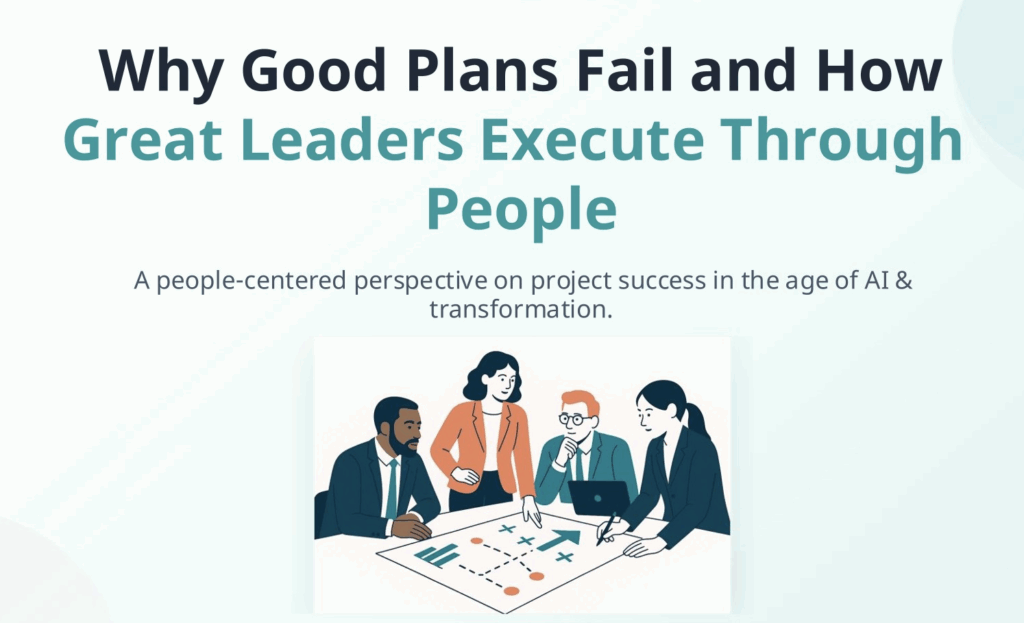
## Executive Summary
Project success is rarely a matter of luck; it's a reflection of planning quality, team competence, and execution discipline.
According to PMI's Pulse of the Profession (2023), 39% of projects fail due to poor planning, and 70% of all projects experience major challenges despite having formal plans in place. The difference between success and failure often lies not in the Gantt chart but in the people executing it.
At Conult Health Analytics, we believe that plans set direction, but people deliver outcomes. Our program execution model fuses disciplined planning, competence building, and human-centered leadership—ensuring that strategy translates into measurable impact.
In this piece, we will:
- Examine the dual failure points of poor planning and weak execution
- Explore research from PMI and real-world data on project outcomes
- Explain how people-centered management bridges the gap
- Share our operational principles at Conult Health Analytics
The Planning Fallacy: When Strong Strategies Still Fail
PMI's 2023 Pulse of the Profession report is clear: projects that neglect structured planning are 39% more likely to fail. However, even well-planned projects often stumble. Why? Because human systems, not project schedules, break down first.
Common Root Causes:
Unclear priorities: The plan is detailed, but the "why" is missing.
Erosion of trust: Stakeholders disengage when communication falters.
Reactive leadership: Execution shifts from proactive strategy to crisis management.
The PMI data highlights that one in three projects fails primarily due to poor communication. In essence: weak human alignment turns even good plans into fragile ones.
Beyond Planning: Execution as a Human Discipline
Plans define what must be done; people determine how it gets done.
Execution excellence requires project leaders who can translate structure into energy, who balance clarity with compassion, and process with adaptability.
At Conult Health Analytics, we anchor execution in three human-centered principles:
1. Empathy Before Efficiency
Deadlines don't drive results—people do.
Understanding team capacity, morale, and context ensures sustained performance. Our delivery cadence includes "pulse checks," not just "status checks."
2. Clarity Before Compliance
A team aligned around a shared "why" will outperform one that simply follows protocol.
Every project kickoff begins with an impact narrative—who benefits, what changes, and how we'll measure progress.
3. Trust Before Timelines
High-trust environments accelerate decisions and reduce hidden risks.
We embed transparency through open dashboards, visible blockers, and retrospectives where lessons are shared—and not punished.
These may sound "soft," but they directly reduce rework, increase velocity, and build durable accountability loops.
The Data-Driven Case for Competence
PMI's Talent Gap Report (2023) estimates that organizations will need 2.3 million new project management professionals each year through 2030, primarily because competence directly drives execution performance.
The same report found that:
- Organizations with mature project management practices waste 28x less money than those without.
- High-performing organizations (those meeting 80%+ of goals) invest more heavily in training, mentorship, and PMO capability building.
In other words, talent and structure amplify each other: a sound plan without capable execution is inertia in disguise.
How Conult Health Analytics Applies These Principles
Our hybrid program governance model combines PMI-certified practices with modern adaptive execution:
| Focus Area | Our Approach | Outcome |
|---|---|---|
| Planning Discipline | RACI matrices, risk registers, milestones tied to measurable KPIs | Early visibility into slippage and dependencies |
| Human Competence | Cross-functional PMO with domain fluency in healthcare & AI | Better translation between clinical, technical, and business stakeholders |
| Feedback Loops | Weekly retros, team pulse analytics, user interviews | Continuous course correction |
| Transparency | Open dashboards shared across clients & partners | Accountability and trust |
| Execution Analytics | Predictive risk scoring, task forecasting (AI-powered) | Data-informed decision-making and load balancing |
Our belief: execution is the bridge between vision and value. Every sprint, review, and stakeholder touchpoint becomes a moment to reinforce competence, not just compliance.
Bridging AI and Human Competence
In AI-driven projects like ours, the human factor becomes even more critical. AI may automate prediction, but it cannot automate trust, communication, or ethical judgment.
PMI's Shaping the Future of Project Management with AI (2024) emphasizes that project managers must blend AI literacy with emotional intelligence. At Conult, we see this dual fluency—technical + human—as the new gold standard for leadership.
We integrate AI tools for forecasting and task prioritization but always maintain a "human-in-command" principle: algorithms support, humans decide.
Conclusion: The Human Edge in Execution
Projects don't fail because teams don't care—they fail because we underestimate how much clarity, competence, and compassion drive delivery.
PMI research proves that better planning reduces failure, but better people prevent it.
At Conult Health Analytics, our approach combines both: rigorous plans, empowered teams, and transparent leadership.
In the end, successful execution isn't just project management—it's people management at scale.